Building a Fence on a Slope: How Winchester Yards Get It Right
Flat yards are rare gifts in the Shenandoah Valley. Most Winchester properties roll at least a little, and plenty drop several feet from one corner to the other. The fence still has to look straight, keep the dog in, and hold its line on every inch of that grade.
Slopes do not make fences harder so much as they force a decision most homeowners have never heard of: rack or step. Get that choice right for your grade and material, and the slope becomes a feature. Get it wrong and you live with gaps and awkward angles for years.
How do you build a fence on a slope?
Two proven methods handle nearly every slope: racking, where the fence tilts to follow the grade in one smooth line, and stepping, where sections drop like stairs between level panels. Racking suits steady, moderate slopes and keeps the bottom tight to the ground. Stepping handles steep or uneven grades but leaves triangular gaps that need a plan.
Which one your yard wants depends on three things: how steep the grade runs, what material you have chosen, and whether anything small, a puppy, a rabbit obsessed beagle, a toddler, will be testing the bottom edge. A good installer measures the actual drop with a level and a string line before recommending either.
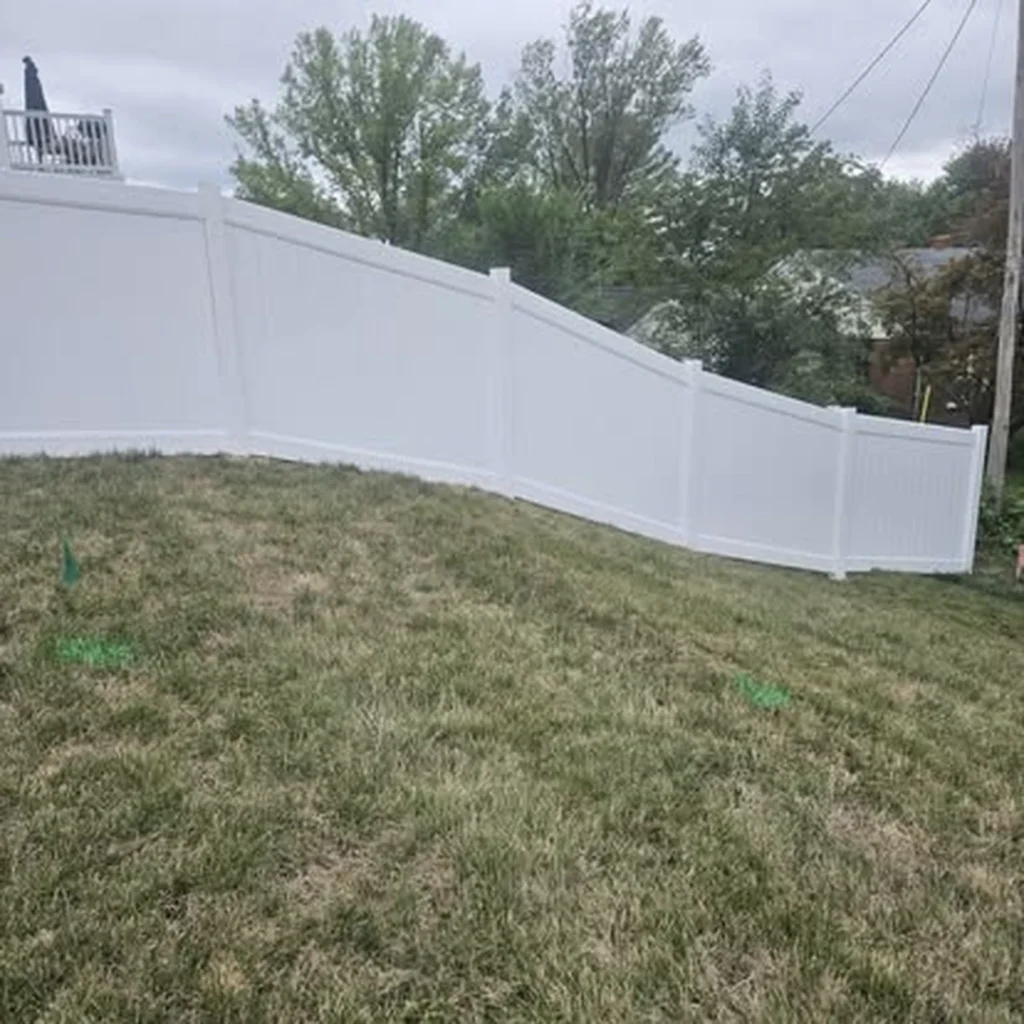
Racking: the smooth line that follows the grade
A racked fence adjusts at every picket. The rails angle with the slope while the pickets stay perfectly vertical, so the fence flows downhill in one continuous line with no gaps underneath. On rolling Winchester yards this reads as calm and intentional, and it is the method of choice whenever containment matters, because the bottom edge hugs the ground the whole way.
The limit is geometry. Every material racks only so far before the joinery binds, and sharp grade changes exceed what a single panel can absorb. Custom built wood fences rack the most gracefully, since each board is placed individually on site. Manufactured panels, vinyl especially, rack within a stated range and no further, which is exactly why steep yards often shift strategies partway down the hill.
Stepping: clean lines with gaps to manage
A stepped fence keeps every panel level and drops between them at the posts, like a staircase wearing a fence costume. On steep grades it looks sharp and stately, particularly with vinyl privacy panels and board on board wood styles that resist racking. Posts get taller and holes get deeper on the downhill side, and the crisp horizontal lines suit formal yards beautifully.
The catch lives under each panel: a triangular gap between the level bottom rail and the falling ground. Small dogs treat those gaps as exits, and mowers treat them as trim work. Fixes are straightforward when planned, awkward when improvised, so the gap conversation should happen at the quote, not after the dog demonstrates the problem.
Which materials handle slope best
Wood built stick style on site is the slope champion, racking smoothly and stepping cleanly, with every cut made to your actual grade. Aluminum comes surprisingly close, since most ornamental panels are engineered to rack a significant amount, which is one reason aluminum shows up on so many sloped front yards around Winchester. Chain link, for all its plainness, follows grade better than almost anything.
Vinyl is the material that demands honesty about your yard. Standard panels rack modestly, steeper grades need special order rackable panels or a stepped design, and pushing a panel past its tolerance voids the clean look you bought vinyl for. None of this makes vinyl wrong on a hill. It makes the measuring tape the first tool on the job, before a single panel is ordered.
Gaps, pets, and finishing the bottom edge
Whatever method wins, the bottom edge deserves a finish plan. Under stepped panels, the classic fix is a kick board, a horizontal board following the grade that closes each triangle, looks tailored, and takes the string trimmer’s abuse instead of your pickets. Filling with soil or stone works on gentle steps, and buried wire mesh handles determined diggers without changing the fence’s look.
Drainage deserves one thought too. Water moves downhill along fence lines on sloped Winchester lots, and a fence should never dam it. Leaving the right clearance, or gapping a kick board slightly, lets storm water pass instead of pooling against posts. It is a small detail that adds years to the bottom of a wood fence.
Bottom Line
Rack the steady grades, step the steep ones, pick a material that matches your slope, and close the gaps like you mean it. A hillside fence built that way looks like it grew there. Winchester Fence measures every sloped yard with a string line before quoting, builds both racked and stepped designs across the Winchester area, and will tell you plainly which method your grade actually wants. Book a walk of the yard and we will bring the level.
Related reading: our fence installation services, Farm and Horse Fencing Around Winchester: Options That Hold, Fence Gate Options and Automation for Winchester Homes